
Unpacking the trade deal with India
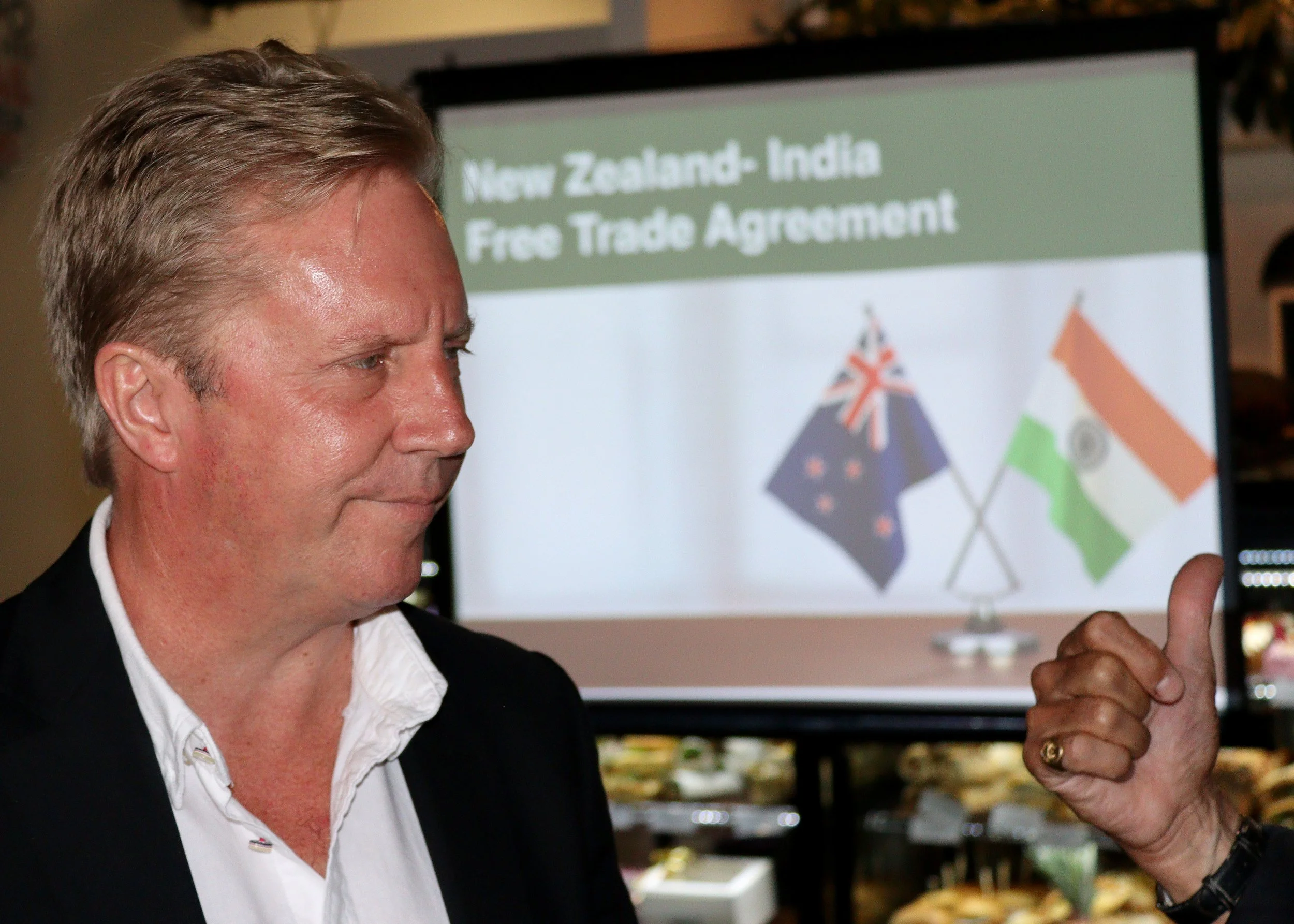
Minister for Trade and Investment Todd McClay talks with Taupō Business Chamber members at a breakfast on Tuesday. Photo: Dan Hutchinson
Trade Minister Todd McClay visited Taupō on Tuesday to push the merits of a proposed trade deal with India.
By Dan Hutchinson
The district’s forestry industry stands to gain from the deal with tariffs to be removed on 95% of forest products.
Forestry is New Zealand’s largest export earner to India and worth $126 million last year, including $71 million in log exports.
McClay says he is confident of cross-party support from Labour to get the deal over the line, despite coalition partner NZ First indicating it will not support the deal in its current form.
The agreement covers 92% of New Zealand's current exports to India. About 80% of exports will face zero tariffs once the deal is fully implemented.
"We have 5 million people. India is 1.4 billion. Their middle-class people with disposable income is 500 million. That's greater than the population of the European Union and the UK."
He pointed to Australia's advantage when it secured its own trade deal with India in 2022. After that deal, New Zealand's lamb exports to India dropped from 89% of the market to just 8%, with New Zealand exporters contending with a 30% tariff, compared with 0% for Australian lamb.

MP for Taupō Louise Upston, Todd McClay and Taupō Business Chamber president Abhinav Batta. Photo: Dan Hutchinson
Deputy Chief Negotiator Jonas Holland told those attending the Taupō Business Chamber breakfast meeting at Baked With Love, that Australian forestry exports to India increased 119% following their trade agreement.
New Zealand log exports to India, once worth $250 million annually, fell dramatically in 2021 to just $28 million after NZ banned the use of methyl bromide to fumigate logs at ports, before finding an alternative. Fumigation is a requirement of most countries receiving logs.
India has since allowed logs back in using methyl bromide fumigation upon arrival in India. It is a temporary solution while an alternative fumigation method is verified and approved for use in New Zealand.
McClay says there is a couple of other products that are “as effective” but that's going through the regulatory system to prove it is as effective.
“They haven't used it before. We're quite close to that.”
Dr Elizabeth Heeg, Chief Executive of the New Zealand Forest Owners Association said in December that New Zealand enjoys a reputation as a reliable, long-term supplier of premium wood products in India.
“India has scale, strong demand for New Zealand wood products, and significant momentum, with its economy forecast to grow to NZ$12 trillion by 2030.
“With improved settings for trade under the new FTA, our growers and processors can build longer-term commercial partnerships and invest more with confidence.”
The countries have had reciprocal trade missions with a forestry trade mission to India in November last year and a reciprocal visit by an Indian forestry delegation in February this year.
Dr Heeg says their visit to India gave them valuable first-hand experience with India’s forestry policies and its fast-growing domestic market.
“There is a clear pathway to turn that interest into more trade, especially in higher-value processed wood products.”
Dr Heeg also welcomed the agreement’s emphasis on collaboration, including cooperation on research, education and forestry practice, to support stronger productivity and sustainability outcomes for both countries.
“That practical work will help lift capability in the sector, while the agreement itself gives growers and processors a stronger base to increase trade with India. Put together, it’s a great outcome for forestry and a great outcome for New Zealand.”
Other agricultural products stand to benefit, especially wine, where exporters contend with 150% tariff. That could drop to 30% or 50% depending on the value of the wine.
Apples and kiwifruit are big winners, but most dairy products are excluded from the agreement, as is the case with other countries that have negotiated trade agreements with India.
McClay says an important part of the agreement is that if other countries negotiate a better deal for certain products in the future, then New Zealand will have those benefits retrospectively added to the deal.
With the European Union currently negotiating, McClay says it is important they get the deal across the line before the end of the year, to make the most of that clause.
New Zealand also secured a tariff-free quota for kiwifruit that is four times larger than current annual sales to India.
Honey exporters will see tariffs drop from 66% to 16.5%, marking the first time India has reduced honey tariffs.
MP for Taupō Louise Upston travelled to India with McClay and Prime Minister Christopher Luxon in March, and says the deal making has been “relationship-based” rather than “transactional”.
The agreement extends to services provisions. New Zealand service providers in industries like engineering, architecture, accounting, education and research will be able to set up operations in India.
In return, New Zealand will accept 1,670 skilled workers annually from India in areas facing shortages, including ICT professionals, construction engineers, nurses and healthcare workers.
The agreement could be New Zealand's third major trade deal completed in the current parliamentary term, following agreements with the UAE and Gulf Cooperation Council countries.
Labour completed a trade deal with China in 2008 which was significantly upgraded in 2022.