
Keeping an eye on Taupō
By Dan Hutchinson
Earth Sciences New Zealand opened its doors to local students last week for Earth Day, showcasing the advanced research capabilities housed at its Taupō laboratory.
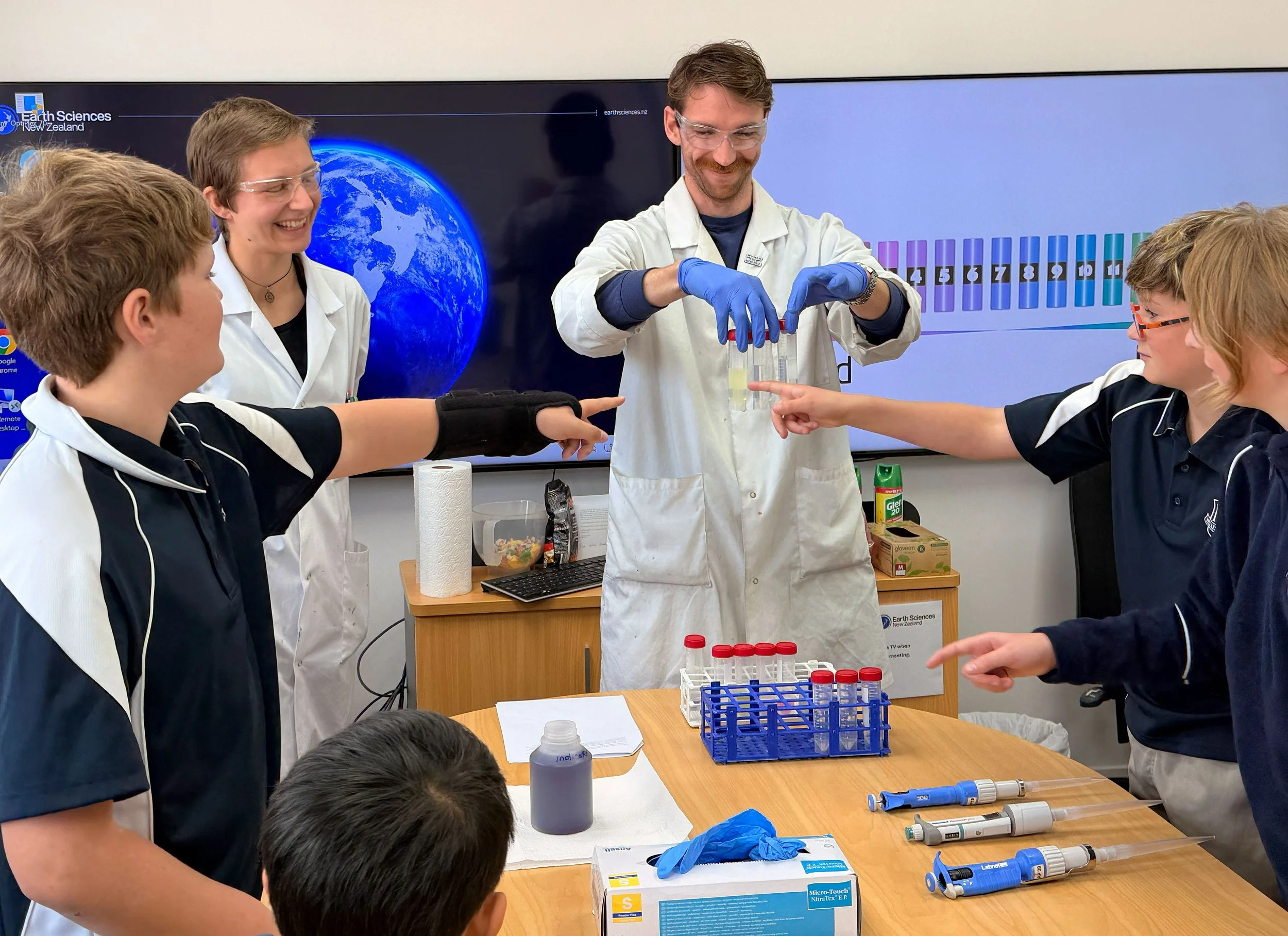
Scientists explain the complicated chemistry that is happening all around us.
The facility, which combines GNS Science and NIWA operations under the new Earth Sciences New Zealand banner, hosted eight interactive stations for students to explore different aspects of earth sciences research.
A final experiment saw scientist simulate a volcanic eruption using a 40-gallon drum filled with plastic balls.
"For a small town to have, I think a world leading group of scientists and technicians that are really trying to solve really big hairy problems, and to have it right here in Taupō is actually a real significant boon," says Geoff Kilgour, Earth Science chief scientist volcano hazards.
The laboratory at Wairakei houses about 70 staff working across geothermal energy, volcanic monitoring, and groundwater research.
Their work includes volcanic eruption monitoring systems and support for the region's geothermal industry.
Students observed ocean acidification experiments led by scientist Lucjan Sajkowski, who demonstrated how carbon dioxide emissions affect seawater pH levels.
The facility's earthquake monitoring capabilities were demonstrated through interactive sessions where students created their own seismic activity.
Lead technician Cam Asher, who ran the earthquake station, had students jump to create vibrations that were detected by seismometers just outside the building.
The laboratory's monitoring network provides automatic earthquake detection almost immediately with accurate results within one minute of occurrence.
The system monitors not only earthquakes but also volcanic activity, landslides, and tsunamis across New Zealand.
Geothermal geologist Lucy Carson showed students rock and mineral samples under microscopes, revealing the complex structures invisible to the naked eye.
Her station focused on geothermal energy systems and the challenges of maintaining equipment in harsh underground conditions.
"Even if you find them kind of boring, they look way cooler closer up," Carson told students.
Lucjan came from Poland to work at the facility. The laboratory houses a unique analytical chemistry facility capable of processing highly acidic samples from volcanic and geothermal environments worldwide.
The lab can recreate extreme conditions found several kilometres underground, with temperatures reaching 400 degress Celsius and corresponding pressure levels.
"This is one of the few labs in the world that can actually do this kind of stuff," Kilgour says.
The facility analyses samples from other locations on the so-called Ring of Fire, including the Philippines and Indonesia and conducts experiments to solve practical problems such as steel corrosion in geothermal wells.
The Taupō site's location stems from the 1950s development of the Wairakei geothermal field, with the facility expanding over decades to include volcanology and groundwater science.
The laboratory maintains close working relationships with local geothermal companies.
Students also explored volcanic monitoring technology, learning about the sensor networks positioned around Lake Taupō and the central North Island volcanoes including Ruapehu, Tongariro, and Ngauruhoe.
The monitoring extends beyond the immediate region to cover volcanic activity across New Zealand. There is now tsunami monitoring stations in Lake Taupō following the earthquakes and subsequent small tsunami that hit the area in 2022.
Senior communications advisor Elizabeth Garlick, who helped coordinate the student visit, said the event coincided with Earth Day celebrations on April 22 and helped raise awareness of the facility's capabilities within the local community.
"The idea is to try and make this a way of opening our doors so that people can understand not only what we do, but why we do things," Kilgour says.
The laboratory's work supports New Zealand's transition away from fossil fuels through geothermal energy research, and provides crucial hazard monitoring services, including the lahar warning system for Ruapehu, used by skiers and local communities.