
Tūrangi commuters demand better service
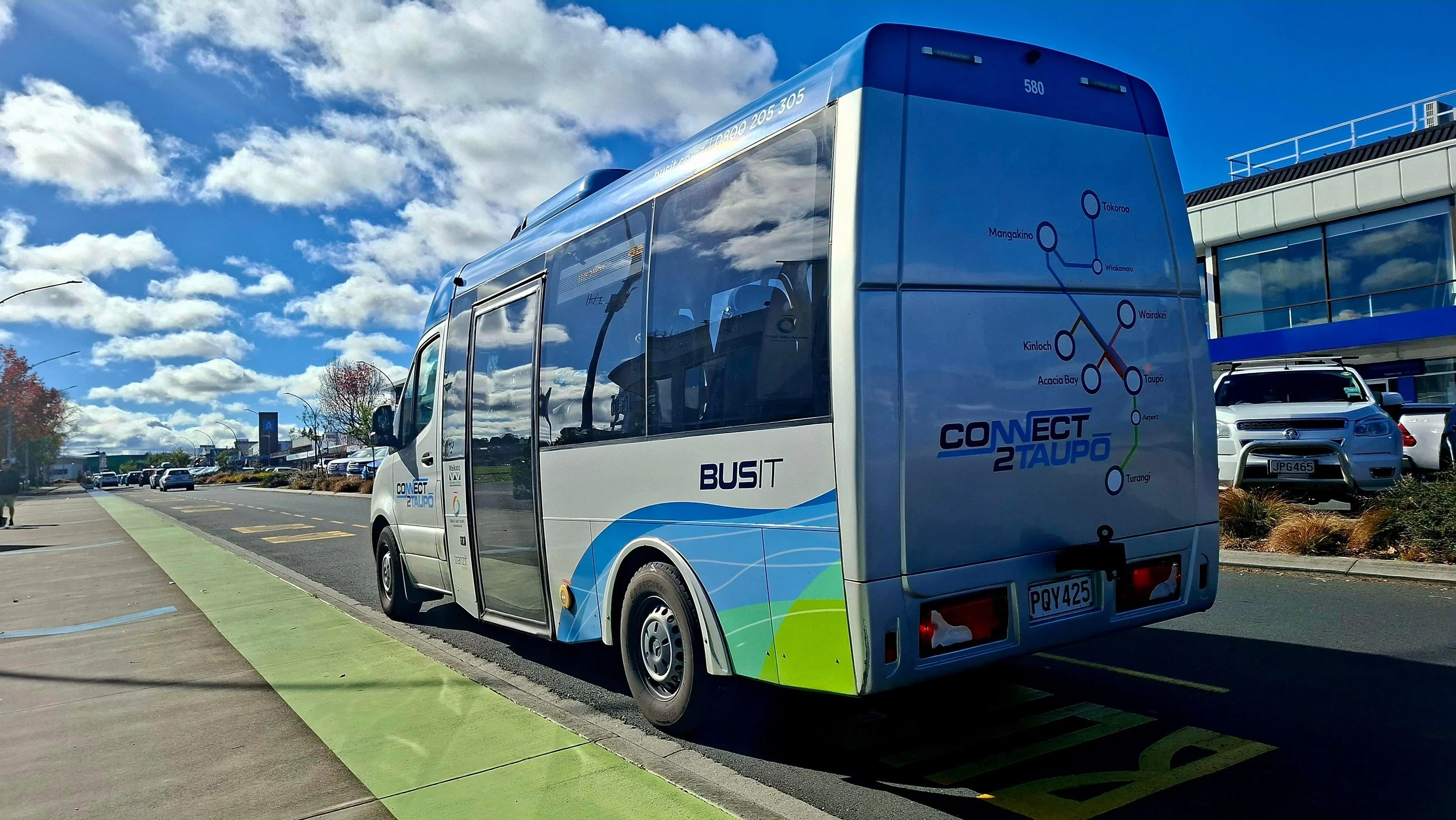
The Tūrangi-Taupō 'shoppers' bus' departs from the Taupō Great Lake Centre on Tongariro St. Photo: Bronson Perich
With the cost of fuel at an all-time high, Taupō District Council Tūrangi councillor Sandra Greenslade says her ward needs a commuter bus.
By Bronson Perich - Local Democracy Reporter
The current service between Tūrangi and Taupō, an 11-seater bus, operates twice a day on Mondays and Thursdays.
Greenslade said her constituents needed more services, because while many lived in the Tūrangi ward, they worked in Taupō.
“The shoppers’ bus is fine, although [it] could be another day.
“But why can’t we have a bus that would get people to work?”
Public transport is a responsibility of the soon-to-be-axed Waikato Regional Council (WRC).
Lowest patronage in Waikato
The regional council has funded and managed the Connect-2-Taupō bus service since 2022, carrying passengers from Taupō, Mangakino, Tokoroa, Tūrangi and Kinloch.
But it said Taupō district patronage numbers were low and declining across the board.
It said only 353 people had used the Taupō-Tūrangi bus from January to March this year.
Greenslade told Local Democracy Reporting that her constituents had stopped using the service because the bus was too small.
She said her friends in Omori and Kuratau would come into Tūrangi, only to find the small buses were full.
“All the people have come to me and said their reliability of being able to get on the bus is so hopeless that they’ve stopped using it.
“They’ve got sick of having to turn up half an hour beforehand at this end, and then at the other end ... to make sure they’re going to get a seat.”
She also said bus patronage numbers needed to be compared with the total population of the areas they served to paint an accurate picture.
“We’re actually using the bus exactly the same as Taupō people are.
“They’ve got 18,000 people and we’ve got 5000 people, and that’s the difference.”
She was confident that, if a commuter bus got the green light, her constituents would support it in force.
“They’re desperate to use it!”
Getting council on board
Regional councils are required to create and implement regional transport plans.
WRC delegates that function to its regional transport committee, which consists of councillors from the Waikato region and representatives from outside entities such as the New Zealand Transport Agency Waka Kotahi.
The Taupō district delegate on that committee is Duncan Campbell, a traffic engineer-turned-councillor.
Greenslade paid tribute to Campbell in championing her constituency’s cause at regional level.
“He’s just come out and fought for our community.”
For Campbell, a Taupō-Tūrangi commuter bus is a no-brainer.
“There’s always been a want for better public transport,” he said.
“Commuter public transport makes the most sense for Tūrangi, especially in this fuel crisis we have now.”
He said he tabled a request to add a commuter bus to the Waikato regional transport plan in March, and would put forward a proposal in June.
Regional transport committee chairwoman Liz Stolwyk said she understood small towns such as Tūrangi needed viable transport options.
”We look forward to councillor Campbell’s proposal in June.
“We also anticipate receiving more proposals from other parts of the Waikato Regional Council as well.”
Ministry-funded buses
But even if the regional council greenlit the Taupō-Tūrangi commuter bus, Greenslade said her ward could still lose out because of the school buses.
The Ministry of Education funds four school bus routes in and around Tūrangi, bringing children to schools in Tūrangi and Kuratau from places such as Waitetoko, Rangipō and Omori.
Greenslade said she was concerned that, if WRC approved a commuter service, the ministry could cut the funding for the four school bus routes.
Local Democracy Reporting asked the Ministry of Education the following questions:
What would be the criteria for reducing or closing down [those] bus services within said area?
How would a Monday-Friday morning and afternoon commuter bus service operating from Tūrangi-Taupō affect the eligibility for Ministry of Education-funded school bus services in the Tūrangi Ward of the Taupō District?
James Meffan, the ministry’s general manager of school transport, responded that, to be eligible for school transport assistance, students must meet the following long-standing criteria:
The student must attend their closest state or state-integrated school.
The student must live more than a certain distance from the school:
Years 1-8: At least 3.2 km
Years 9-13: At least 4.8 km.
There must be no public transport available.
The ministry defines public transport as a service that:
travels within 2.4km of both the student’s home and school
does not pick up students before 7am and gets them to school on time
collects students within an hour of school finishing
does not need the students to change buses more than once on a journey.
Greenslade says fighting for a bus hasn’t been easy, but she’s not giving up yet.