
Full steam ahead for power station
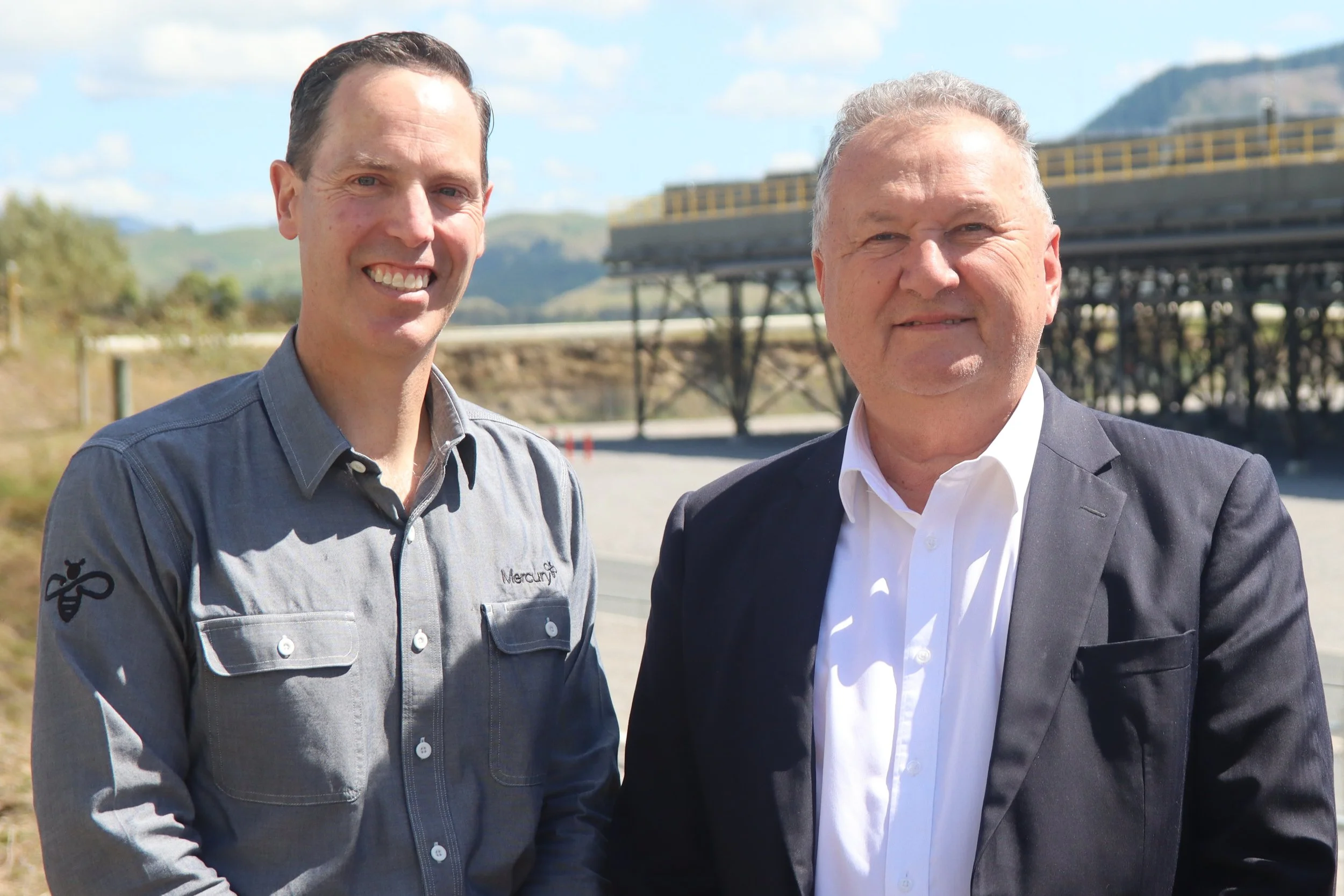
Mercury Chief Executive Stew Hamilton and Associate Minister of Energy Shane Jones open the new generation unit on Tuesday.
Mercury has officially opened its $220 million expansion project at its Ngā Tamariki Geothermal Station near Taupō.
The $220 million expansion project adds a fifth unit to the power plant capable of generating 55MW – more than twice the capacity of each of the original units commissioned at Ngā Tamariki in 2013.
Mercury Chief Executive Stew Hamilton and the Associate Minister of Energy Shane Jones opened the new generation unit on Tuesday with mana whenua, Ngāti Tahu Ngāti Whaoa, Tauhara North #2 Trust, landowners, community leaders and some of the 300 contractors and staff who worked on the project over the past two years.
In parallel with the project, Mercury has drilled two new geothermal wells; one to provide additional steam supply for the new generation unit and the second for the reinjection of geothermal fluid and gases back into the field.
That helps support the sustainability of the geothermal field and reduces the amount of gases like carbon dioxide being released into the atmosphere, Stew says.
"We can now reinject gases across the entire station and this will help us achieve a 70% reduction in the station’s carbon emissions by 2030.”
Geothermal energy plays a key role in improving the country’s energy resilience because it provides a constant baseload supply.
Stew says they are also partnering with the Government on its investigation into supercritical geothermal energy.”
The Government has provided $60 million in funding to help develop supercritical and the first site has been chosen for exploratory wells in the Rotokawa Geothermal Reservoir near Taupō.
Supercritical geothermal requires drilling deeper and extracting hotter fluids that can generate significantly more power. The technology is still in development
Tim Groser, chair of the Supercritical Geothermal Project board, told Radio New Zealand’s The Detail that New Zealand has the best chance "to try to be the first country to actually crack the engineering problem".
"It will actually be as close to what I'd call a silver bullet in terms of what is really required on climate change," says Groser, a former climate change minister.