
Training for danger
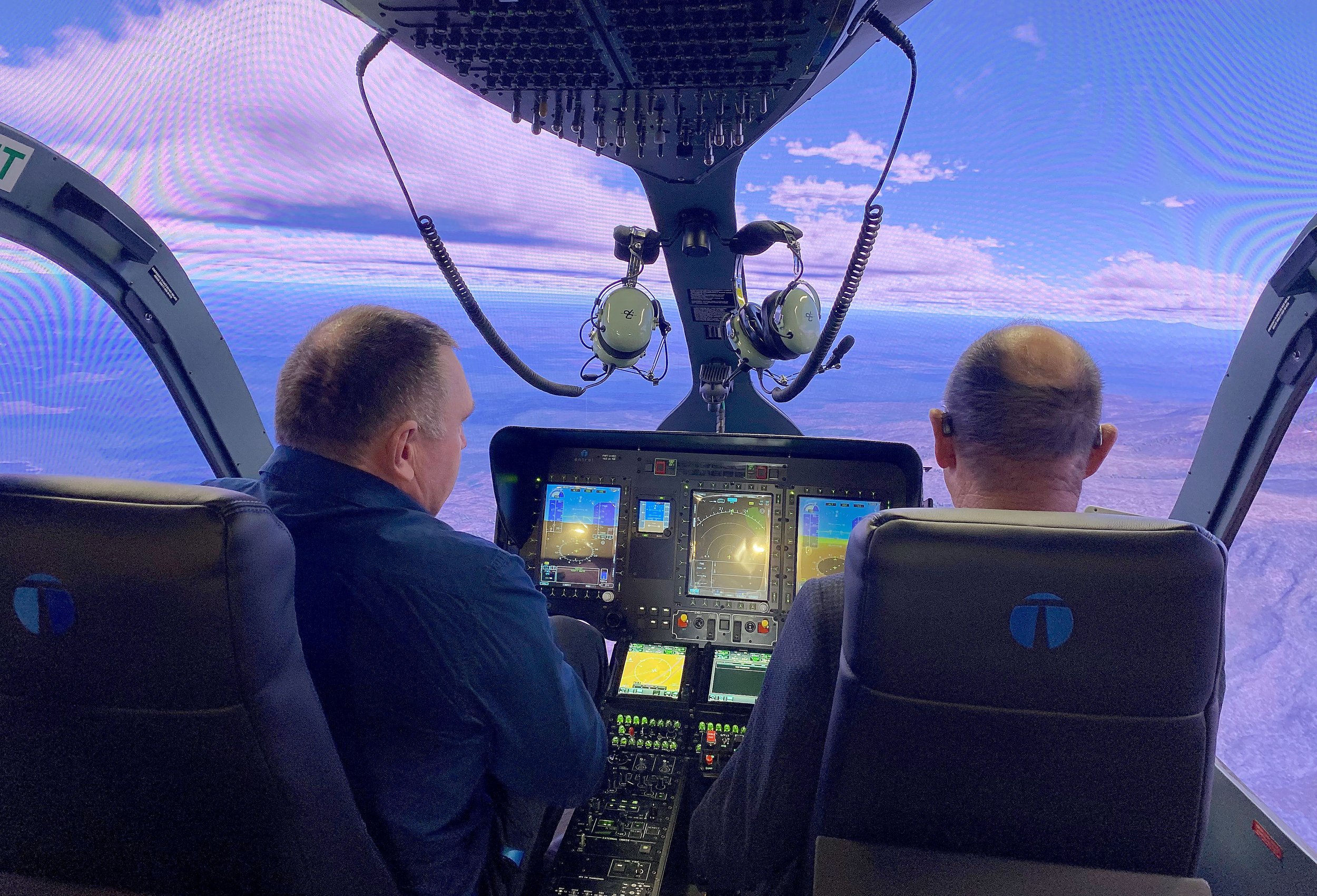
Taupō Mayor and helicopter pilot John Funnell (right) gets a briefing on how to use the new flight simulator during the opening of the new training centre. Photo: Dan Hutchinson
Search & Rescue Services has opened its new Miro Street Centre of Excellence in Taupō.
The purpose-built training facility features cutting-edge flight and medical simulators designed to prepare crews for emergency rescue operations across central New Zealand.
The facility was blessed by Ngāti Tūwharetoa on Monday, and will serve as the training hub for crews from five rescue helicopter trusts that operate a fleet of rescue helicopters from eight bases across the North Island.
Search & Rescue Services chief executive Paul Baxter says the facility gives their people a “safe place to train for those unsafe environments”.
"Every day, our crews are asked to make difficult decisions in difficult places — on a mountain face, above the deck of a vessel, on the side of a road, or while transporting critically unwell patients between hospitals."
At the heart of the facility is an Entrol H145 flight simulator manufactured in Spain. The simulator includes augmented and mixed reality hoist training capability, allowing pilots, air crew officers and paramedics to train together as a whole crew in realistic, scenario-based exercises.
The simulator replicates the actual terrain and environments the crews cover, from Ngāuruhoe to the Auckland Hospital helipad.
"The simulator lets us create scenarios that we cannot recreate in the aircraft simply because the aircraft won't let you do it because of its inbuilt safety systems," Baxter says.
The facility also houses a high-fidelity Laerdal clinical simulator supported by technology that enables simulation sessions to be managed, recorded and delivered remotely across the organisation's eight-base network.
A dedicated lecture room, briefing and debriefing spaces, and provision for a future practical rescue skills area with a full-size helicopter training mock-up complete the facility.
Search & Rescue Services operates from eight bases across the North Island — Hamilton, Tauranga, Taupō, Gisborne, New Plymouth, Hastings, Palmerston North and Wellington — with more than 150 pilots, critical care paramedics, air crew officers and support staff on call 24 hours a day, seven days a week.
The government has committed $128 million NZD in rotary wing air ambulance funding, with an additional $14.7 million NZD invested to replace ageing helicopters with new Airbus H145 D3 aircraft.
The new five-blade H145 D3 helicopters offer improved safety, greater reliability, enhanced bad-weather capability through Instrument Flight Rules technology, reduced maintenance costs and better operational performance. Demand for air ambulance services has increased by 22% in five years.
"We call this our Centre of Excellence not because excellence is a label that we give ourselves, but because excellence is something we have to practise," Baxter said. "It is something we have to build, test, challenge and improve every day."
Search & Rescue Services is owned by five regional community charitable trusts and sustained through the generous support of sponsors and donors alongside significant government investment. Operations cost around $70 million NZD a year, with government funding through Health New Zealand and ACC covering a large proportion, but a significant portion still met through trust fundraising, sponsorship and community donations.
David Wright, chair of Search & Rescue Services, emphasised the importance of community support.
"Government funding has grown significantly, but it does not cover the full cost of delivering the service. And that is why sponsorship matters. Sponsors matter."
Taupō Mayor John Funnell, a former rescue helicopter pilot, praised the facility's infrastructure.
"What you've created here is more than a building. That's a place of learning, innovation and preparedness. A place where pilots, air crew officers and paramedics train together just as they operate in the real life."
The facility will also feature a large mural by local artist Kingi Pituroy, connecting the centre to Ngāti Tūwharetoa and reflecting the work crews do across ocean, earth and sky.