
Thinking outside the box
By Dan Hutchinson
A new suburb at the southern end of Taupō township has taken a decidedly Scandinavian approach to lifestyle and town planning.
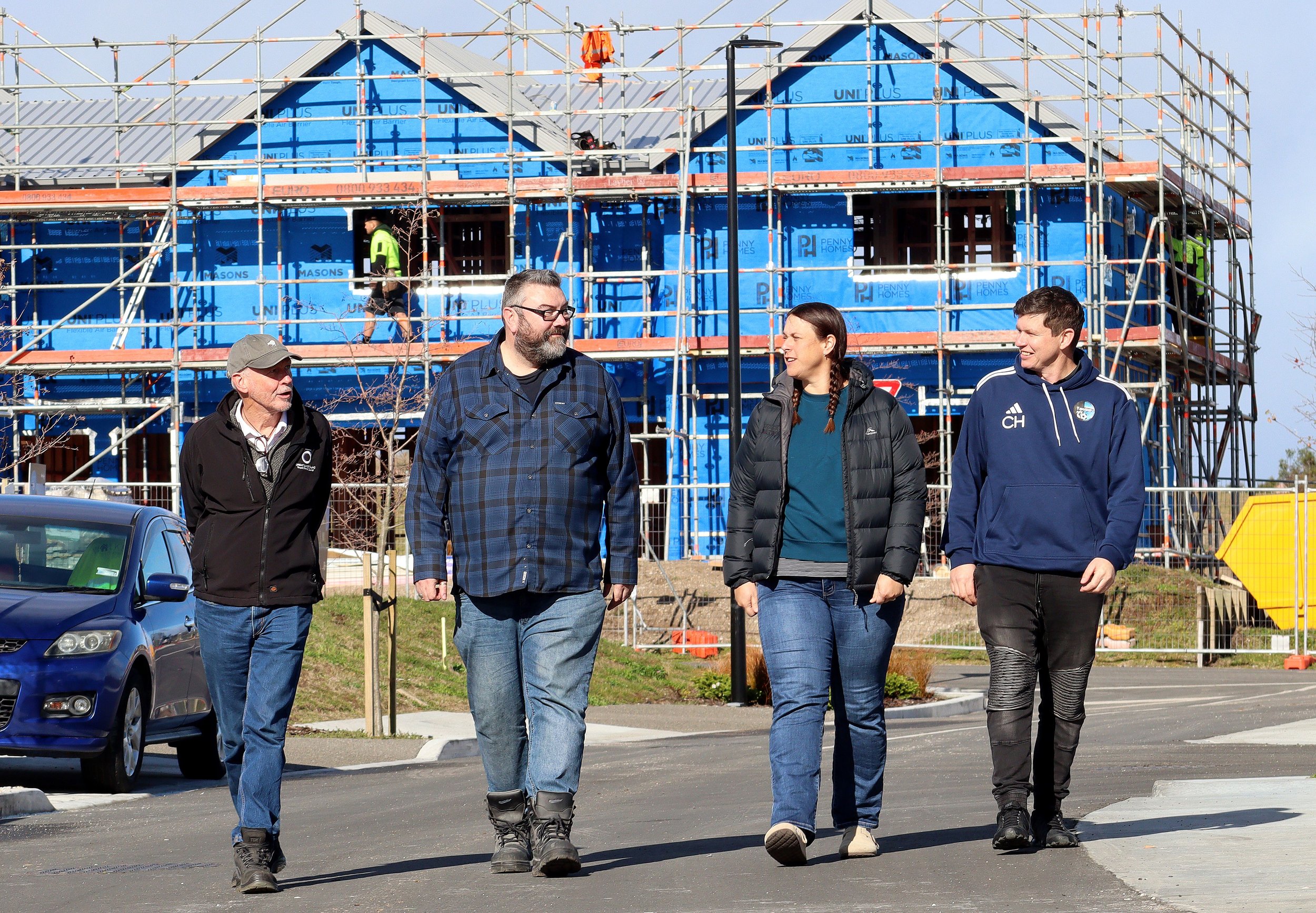
Taupō District Council staff wander through the new affordable housing being built at Oroko Rise, from left; senior communications advisor Andy Taylor, senior project manager Pete Bradshaw, property and development manager Chris Haskell and general manager of organisation performance Sarah Matthews. Photo: Dan Hutchinson
In addition to Kokomea Shopping Centre, the adjacent Lakecrest Lifestyle Village, and the wider, relatively dense housing developments, is Oroko Rise – a mix of affordable and market rate homes.
Sewage and Water upgrades have been completed to cater for the growth at the southern end of town, which could be considerable, given the council owns enough land for another 1200 sections in the area.
What is special about Oroko Rise is the focus on affordable housing, which recently won the Excellence in Collaborating for Results award at the Local Government Excellence Awards.
Oroko Rise is a partnership between Taupō District Council and a consortium of Penny Homes, Classic Builders and Tūwharetoa Settlement Trust.
The 116-home development includes homes sold at market rates alongside homes being offered to working people trying to get into their first home or starting over with a low deposit.
Of the 62 homes in the first stage of the development, 32 are ‘affordable homes’ - two-bedroom homes priced at $550,000 and three-bedroom homes at $650,000 for qualifying buyers.
About 60% of the first stage of 62 homes sold in just eight months — well ahead of the three-to-four-year timeline originally projected.
Council property and development manager Chris Haskell says the mix of affordable and market-rate homes sitting side by side is central to the project's philosophy.
"If you just have affordable in here, that's where you can sort of tend to turn into undesirable areas.”
The affordability is driven by standard house designs, bulk procurement and small section sizes. There is provision for some off-street parking, but most vehicles are accommodated in parking bays incorporated into the streets.
The development features standalone homes, duplexes and triplexes on sections averaging 240 square metres, with green spaces, pathways and connections to nearby shops and services.
Council general manager of organisation performance Sarah Matthews says the project had to stand on its own financially from day one.
"What was also clear was that there was no appetite for ratepayers to subsidise this project. So, we had to rethink how to achieve the outcomes the community wanted while also delivering financial returns to Council and our ratepayers.”
The council acts as the developer — installing roads and infrastructure before selling sections to the consortium at market value. The consortium then builds and sells the completed homes.
To make the affordable homes financially viable, the consortium invested $5 million upfront to build turnkey homes, making it easier for buyers to secure lending.
Affordable homes follow a set exterior design to keep costs down through efficient procurement and duplication of plans, while market-rate lots give buyers more flexibility within the overall development typology.
To qualify for an affordable home, buyers must meet a set of criteria: being a first home buyer or qualifying previous homeowner, meeting an income threshold, being a Taupō District resident or holding a permanent local job offer, and committing to occupy the home for a minimum period.
Matthews says the pace of sales has exceeded expectations, and the project has drawn interest well beyond the local government sector.
"I know we've had interest from government departments, central government as well, coming to have a look at what we've done here.”
For Penny Homes director John Penny, it's the human side of the project that stands out most.
"One of the most rewarding aspects of Oroko Rise has been meeting individual homeowners who can now afford a house because of this partnership. Seeing families get into a warm, well-designed home of their own is exactly why projects like this matter."
Matthews says the project's success comes down to a genuine willingness among all partners to work through the hard parts together.
"We worked together, challenged assumptions and designed a better solution.”