
Concern over spread of hornets

Tom Walters says the mānuka honey industry, and every industry that relies on pollination faces an existential threat from the yellow legged hornet. Photo credit: Bronson Perich.
A Taupō-based honey exporter has called for a quarantine to protect the district against yellow-legged hornets, a newly discovered pest.
Tom Walters, director of NZ Honey Export Group said an immediate ban on the movement of honey-hives was essential to protecting the local honey industry.
“They eat the bees, and they'll destroy the bees.
“I'm not talking just about honey. I'm talking about all of our whanaunga (relatives) out there with kiwifruit.”
Thirty-three Queen Hornets have so far been found in the Glenfield and Birkdale areas of the North Shore - two more since Friday - 21 with developed nests or signs of nests.
Biosecurity NZ north commissioner Mike Inglis told Radio New Zealand the hornets had not spread yet from Glenfield and Birkdale.
With the exception of Majorca, an island off the Spanish coast, every attempt to eradicate the hornet has failed.
Walters said the honey industry was helping Māori landowners to diversify their income streams. Land unsuitable for forestry, sheep, beef or dairy could be suitable for the placement of honey hives.
It is something he has helped implement for the East Taupō Lands Trust, which administers more than 30,000 hectares of forestry, hunting, grazing and beehive lands along the Napier-Taupō Highway.
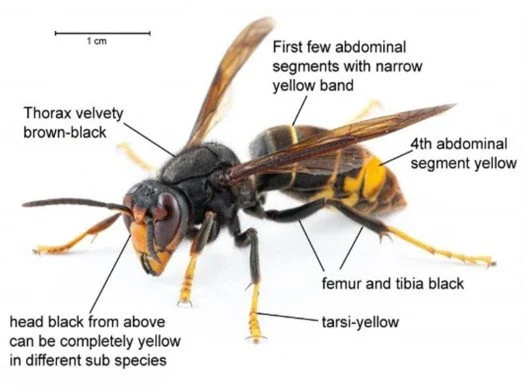
The yellow-legged hornet has unique identifying features including being much larger than a wasp. Photo: Biosecurity NZ
Thus, honey has become a key business for Māori landowners, a business hornets could very well destroy.
Apiculture NZ represents all sectors of the apiculture industry, including more than 8,000 domestic beekeepers.
Its chief executive Karin Cos said honeybees had no natural defence against yellow-legged hornets.
Apiculture NZ has yet to endorse Walters’ call for a quarantine, as it was still seeking technical advice on the yellow-legged hornets.
Biosecurity NZ is the department of MPI (Ministry for Primary Industries) which is leading the charge against these yellow legged hazards.
Inglis said current evidence suggested a quarantine may make little or no difference.
“The yellow-legged hornet is not spread by the specific movement of hives or hive equipment to any greater extent than the movement of any other goods or equipment. There is no evidence that beekeepers spread hornets through their normal beekeeping practices.”
Both Walters and Karin Cos noted that the honey industry has yet to recover from the impacts of Covid-19.
Cos said before Covid-19, there were about one million honey-hives in NZ and that number had halved, due to oversupply and a reduction in demand.
MPI urges any sightings of the hornets to be reported either online at report.mpi.govt.nz or by calling the exotic pest and disease hotline, 0800 809 966.