
A trip up the Old Coach Rd
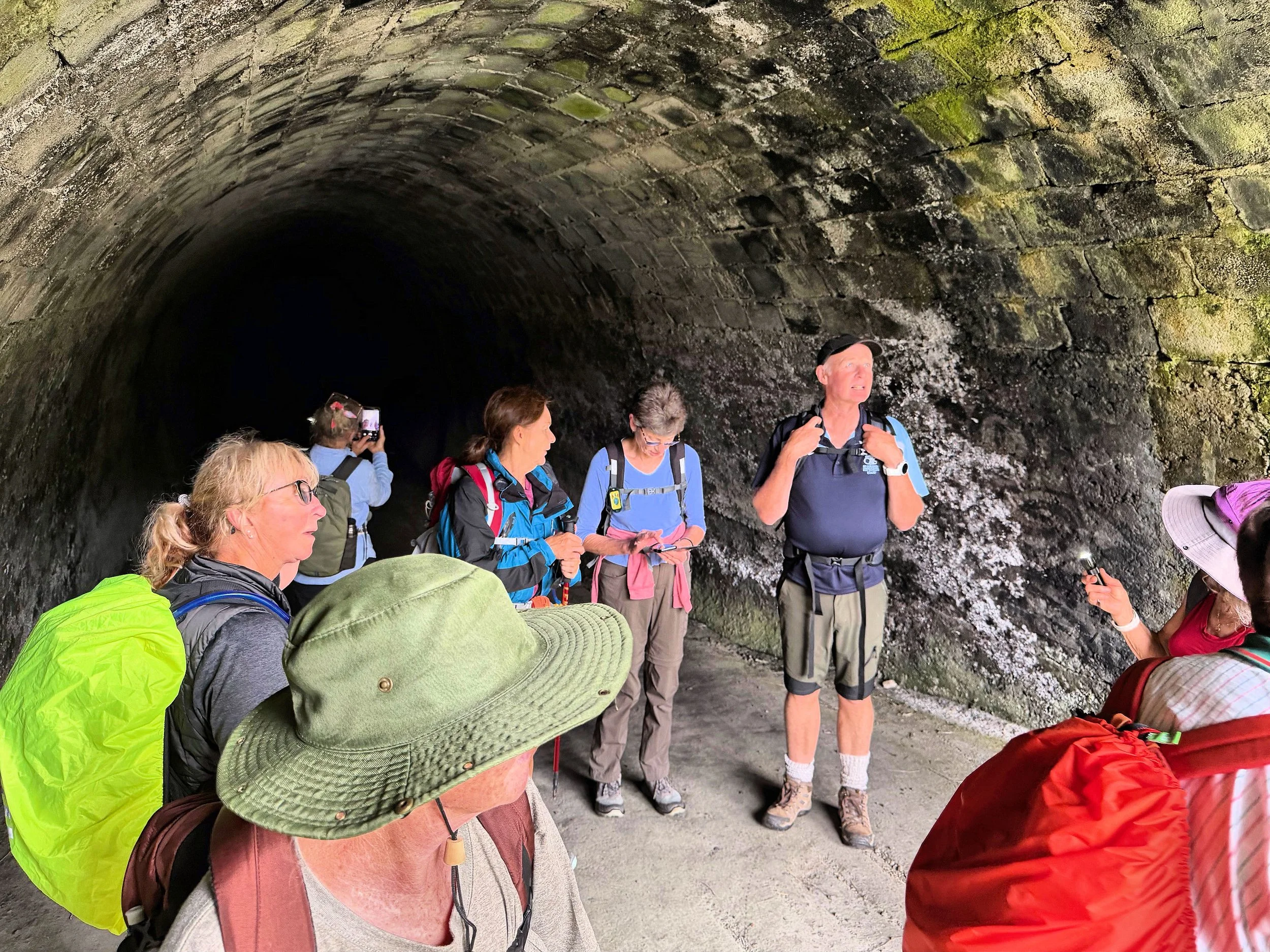
Checking out the disused tunnel.
We emerged from our cosy cocoons, aka bus and van, just as a little splash of blue appeared in the sky and the mist curtain lifted.
The Horopito entrance to the Old Coach Road Trail led straight into bush which today was a glistening green thanks to rain the previous night.
Tōī or mountain cabbage trees were grouped on an opposite bank, their sword shaped, blue green leaves plumped up with moisture.
The track here is easy with stony sections and we quickly arrived at a viewpoint of the now defunct Haeremaere Bridge.
The middle concrete pillar was cleverly built on an angle to align with the river’s flow, but the gentle gradient and tight curves slowed modern trains, and this section was bypassed in 1980.
Open areas interspersed with bush continued until we reached the Taonui Viaduct Bridge. This was operational between 1908 and 1987.
A magnificent relic from the ‘age of steel’, it is like a giant Meccano stretching up from the river below and then spanning it. Its rusty red appearance now softened and blending in with the native greenery.
DOC signs firmly warned us not to try walking across the remaining spans.
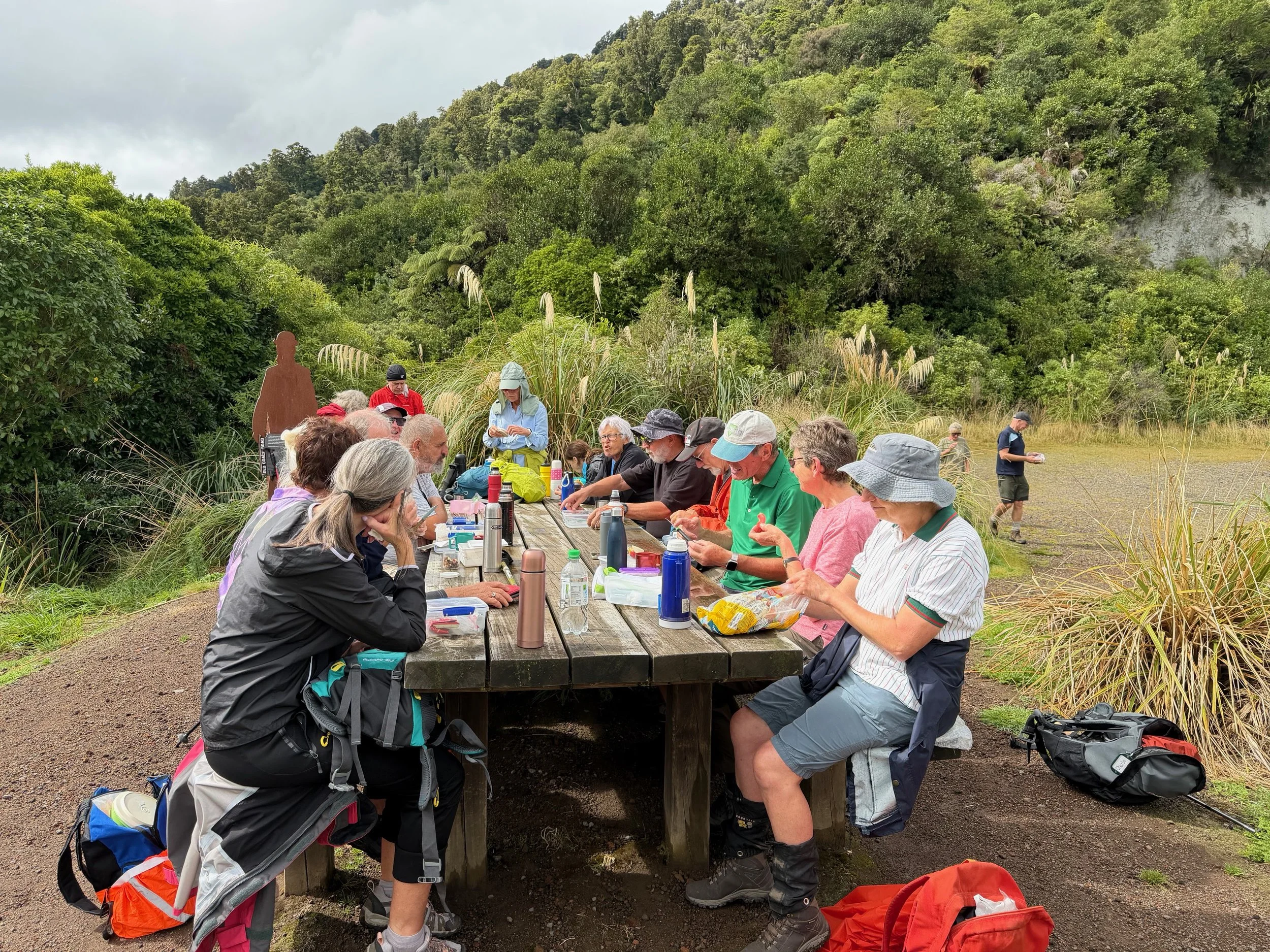
Lunch at the Hapuawhenua viaduct.
The track zig zags down to the river from where we were able to gaze back up the nearly 35 metres of structure.
We were surprised to see a truck-like vehicle moving along the rails of a nearby concrete rail bridge and shared a wave and hello to the workpeople high above us.
In the bush, miro with their tidy branches and fern like leaves were thriving.
In one area we saw a whole circle of huge old rimu, some with trunks bare of foliage but with leafy crowns. Their bark is thick and scaly.
There were also large groups of sturdy tree ferns with matted thick trunks.
A little miromiro or tomtit flew down from a branch and watched us from the path looking very smart with its white waist coat.
Dotted along the track are explanatory notes about equipment, trees and how life was for the workers building the coach road and railway. This trail was built between 1904-1908 to transport travellers over some of the 39 km gap in the main trunk line.
Despite the cold conditions, workers lived in government supplied tents and were expected to maintain and replace the tents themselves.
Contracts were issued to groups of workers to complete sections of work with a small profit to be made over the estimated cost of their labour.
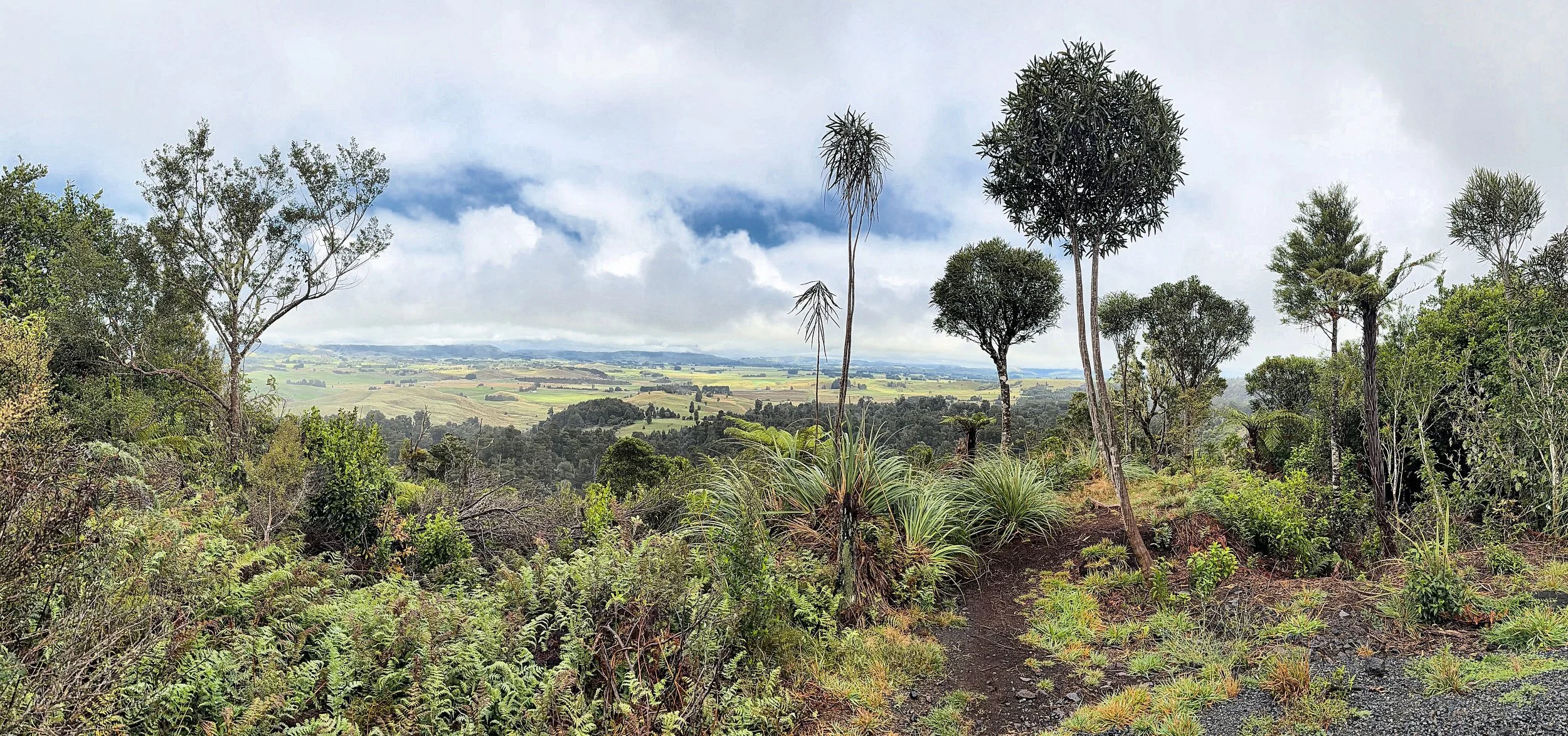
Plenty of land to check out.
Essential equipment for the construction workers was picks, shovel and wheelbarrows while theodolites and chain, made of 100 solid links equalling a length of 22 yards, were needed by the surveyors.
In places we could see the scarred rock faces of dynamited areas.
We read about murderous rātā and saw one entwining a big rimu, once living as an epiphyte on it and then acting as a strangling killer. So much for the beauty of its bright red flowers.
The train line had a rushed completion in 1908 so parliamentarians could travel from Wellington to Auckland to see the US White Fleet.
It must have been an uncomfortable stage of the journey as there was no heating and the ceiling of the carriages had icicles hanging from them.
Near the end of the walking/cycling track is the restored remains of the amazing Hapuawhenua Viaduct. Another steel structure but this one is able to be walked or cycled across.
Crossing this old bridge at 50km/h slowed the heavier and faster ‘modern’ locomotives so in 1987 a concrete replacement was completed.
Electrification of the North Island Main Truck Line has been mooted since 1918, initially because of a shortage of coal, then war time skill and labour shortages and later rising oil prices - sounds familiar - but despite seeing electric wires, we were told that locomotives are predominantly diesel-hauled freight trains and the Northern Explorer Passenger Service.
Torches at the ready we plunged into the darkness of a dead-end railway tunnel, another relic from the past.
The remainder of the track is through bush, sometimes on old cobblestones, and then downhill with wide views of the surrounding farmland.
A great way to experience a sheltered bush walk with plenty of history to absorb but do be courteous towards the numerous cyclists who travel the same route.
Next week is a public holiday, so no walk planned. The following Monday week we have an easy local walk in mind.
If you would like information about our group search Taupo Monday Walkers Facebook or email walkersmondaytaupo@gmail.com