
Tūrangi bus service upgraded
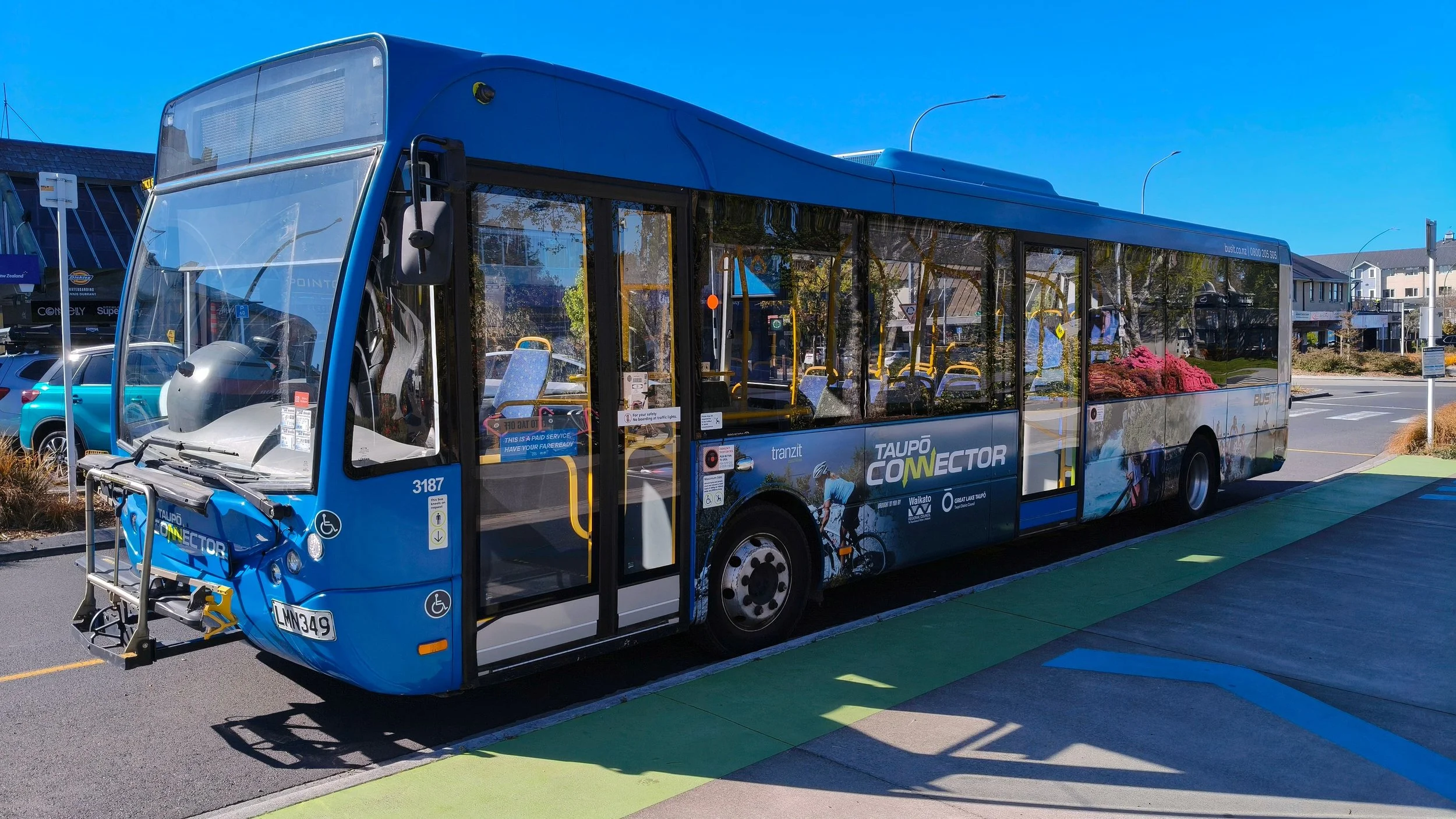
The new Tūrangi to Taupō bus.
The Tūrangi-Taupō bus service has grown, literally.
By Bronson Perich – Local Democracy Reporter
The original 11-seater shuttle that formerly serviced the route has been upgraded to a full-sized passenger bus.
The initial two-day-a-week service now operates on three days: Mondays, Thursdays and Fridays.
However, Tūrangi-Tongariro Ward councillor Sandra Greenslade, who has been fighting for a bigger bus and a commuter service, said while it was wonderful that the regional council listened to her request for a bigger bus, the schedule still prohibits commuters from using it.
“We’ve got three days a week in a very very limited service,” she said.
She said Tūrangi’s service is still lacking, especially when compared to services in other towns.
Waikato Regional Council, which is responsible for public transport across Waikato, has funded a seven-day-a-week service in Raglan, a similar-sized town to Tūrangi.
“I think it’s a bit mean,” Greenslade said.
Whaingaroa (Raglan) is a small town on the west coast of the North Island with, as of 2025, a population of 3910. Tūrangi's 2025 population is 3960.
Waikato Regional Council chairman Warren Maher said in a statement that decisions about new or additional commuter bus services can’t be made based on a checklist of criteria.
Maher said there were a range of things to consider, including funding and demand for a route.
“Co-funding from central government is necessary for public transport authorities to invest in new routes, increased services or additional capacity.”
Maher also said the Raglan and Hamilton route was “consistently popular” and had a long-standing demand from commuters, students and visitors.
“This established... demand has warranted the investment in public transport services.
“The point at which these conditions apply to different towns to secure funded daily public transport services depends on the attributes of both the town and the centre between which the trips would be taken.
“For example, Hamilton as a metro centre will generate more demand for trips to its tertiary level hospital and education facilities, as well as its diverse employment market.”
Why Taupō needs a commuter bus
Some Taupō District residents often travel long distances to get to work: One example is the Te Rāhui Solar Farm on the Napier-Taupō Highway, which is an 86km return trip from the Taupō CBD.
While building the solar farm has brought employment to locals, the cost of fuel makes travelling 86km a day expensive.
So Bam Bam Pile Driving, the company building the solar farm, operates a bus service from its Rakaunui Road depot to the Rangitaiki worksite.
Greenslade told Local Democracy Reporting that she also knew of other companies that provide transport options for their workers as well - a move she called “sensible”.
“People can’t afford to drive to Taupō [from Tūrangi] for jobs any longer.
“$30 or $40 a day in gas; it’s completely unsustainable.”
She said a commuter service timed in line with regular working hours will increase employment opportunities for her constituents and help them meet the increasing costs of living.
Greenslade said limited public transport options reduce the ability of smaller communities to travel, leaving them cut off.
“To isolate a community is a very, very bad thing,” she said.
Transport equity
Taupō Ward councillor Duncan Campbell, as the council’s infrastructure lead, has championed the Tūrangi commuter bus and said he made a submission to the regional council transport committee on Greenslade’s behalf.
To help towns like Tūrangi get the services they need, Campbell is also proposing a “regional-town accessibility standard”.
Under his proposal, residents of regional towns like Tūrangi and Raglan would have “reasonable public transport access” to their nearest “major service and employment centre”, which in this case would be towns like Taupō and Hamilton respectively.
Reasonable access would include services such as a five-day-a-week commuter service and same-day return access to healthcare, government services, shopping and education.
Tūrangi-Taupō bus services a ‘trial’
Maher said Campbell had written an email to regional council Public Transport Subcommittee chairwoman Liz Stolwyk, with regional council staff cc’d, regarding his idea of developing a regional-town accessibility standard.
However, Maher said the regional transport committee had not “formally received information” on the matter.
Maher said for Turangi and the surrounding villages to receive a commuter bus, the regional council needed a business case to assess the appropriate level of service (routes/stops/times/service span) versus the operational cost of running those services for the community.
“Endorsement of the business case by the NZ Transport Agency Waka Kotahi (NZTA) is the pathway for securing co-funding.
“Another way in which the regional council can build a case for new or improved services is to test the level of demand by running trial services.
“Trial services need to run successfully for a minimum of three years before the NZTA can make a decision to co-fund it on an ongoing basis.”
The length of the trial service is timed to coincide with the three-yearly Regional Land Transport Plan (RLTP) and National Land Transport Programme (NLTP) funding cycle, Maher said.
“Subject to co-funding being approved... the regional council could look to then develop a business case for further improvement to those co-funded services.”
Maher said the council would typically do this when the contract for the services is coming up for renewal.
“The Tūrangi-Taūpo service is currently a trial.”
– LDR is local body journalism co-funded by RNZ and NZ On Air.