
Small talk is a big deal for some
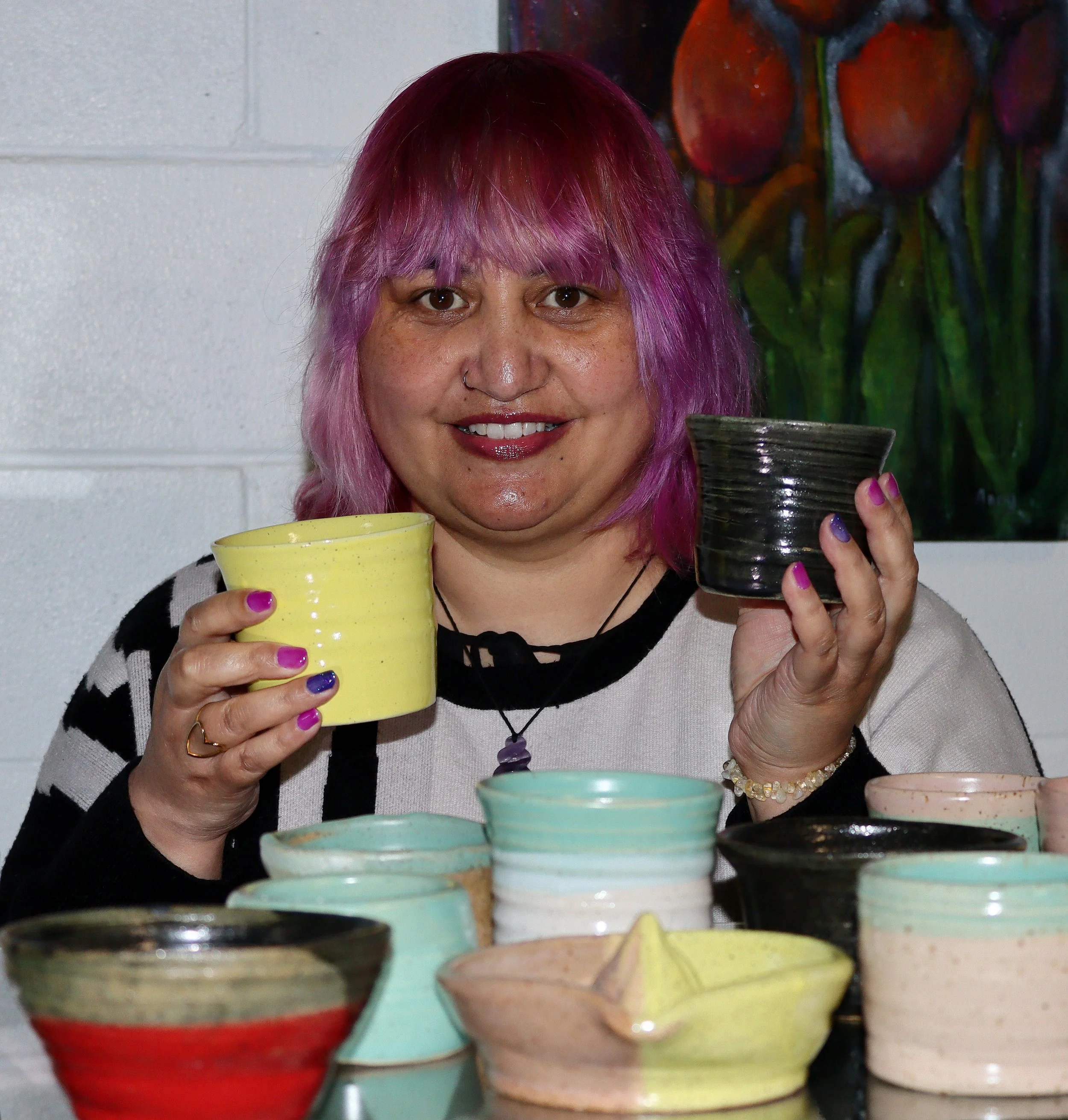
Danya Barnett-Luke displays some of the pottery she has made on the road to recovery. Photo: Dan Hutchinson
A Taupō woman who was completely paralysed as a result of a brain tumour is nearing a full recovery two years on, having relearned to walk and talk.
By Dan Hutchinson
Danya Barnett-Luke was just 39 when diagnosed with a brain tumour in 2024.
It triggered two strokes and multiple seizures, leaving her unable to move any part of her body.
Surgeons at Hamilton Hospital successfully removed the tumour, placing her in an induced coma for two weeks. She woke up paralysed on the right side of her body.
‘‘I was scared mostly. I had my family around me, which was the best medicine for me.’’
After eight months across Hamilton and Rotorua hospitals, she was transferred to a specialised Acquired Brain Injury (ABI) facility in Tāmaki Makaurau Auckland, where she spent a further five months in daily physiotherapy, speech therapy, occupational therapy, and psychological support.
The hardest part, she says, was losing her ability to speak, known as Aphasia.
Aphasia is common for those who have experienced a stroke.
‘‘I couldn’t talk for the first five months at least. And that was the hardest part, not being able to talk and communicate — because I knew what was happening around me, but I couldn’t vocalise anything. I was mute.’’
Her rehabilitation progressed steadily, moving from a wheelchair to a standing frame, then a walker, a four-pronged walking stick, and finally a standard walking stick — eventually walking out of the ABI facility on her own two feet.
Her recovery gained momentum in 2025 after a cranioplasty, in which the piece of skull removed during her original surgery — kept frozen for a year — was reattached.
The procedure instantly restored movement in her arm and improved her speech considerably.
She still experiences occasional seizures, the most recent on Father’s Day last year (September 7), which means she cannot drive, and some tumour tissue remains under monitoring through yearly MRIs.
‘‘I just have to look after myself.’’
Unable to return to traditional employment due to the unpredictable nature of her seizures, Barnett-Luke has started a small business called Tear Up Buttercup, selling pottery she makes through a local pottery group.
Strength in numbers
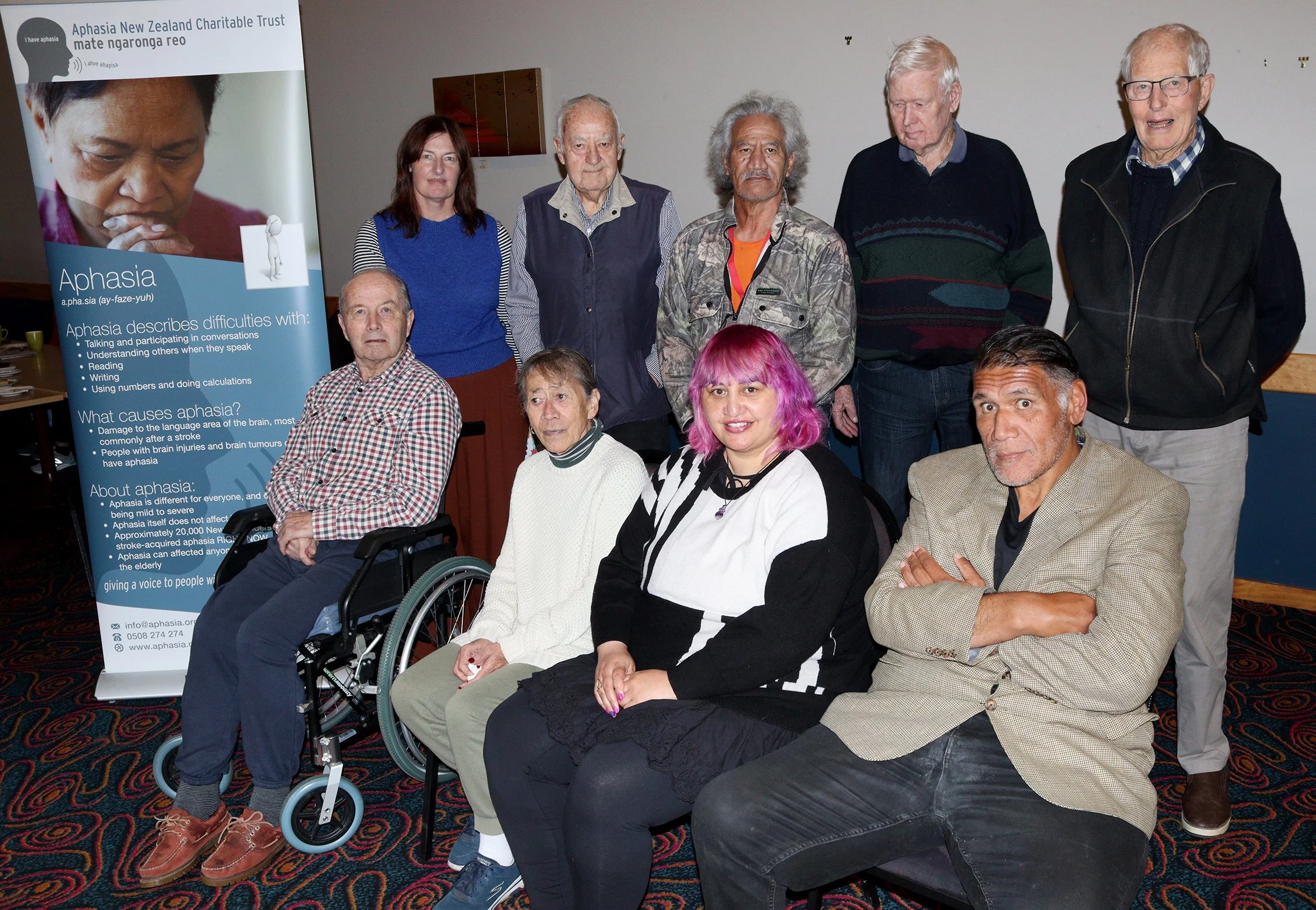
Members of the Taupō and Tūrangi Aphasia group catch up every Thursday at the Taupō Cosmopolitan Club. Photo: Dan Hutchinson
She also attends a weekly Aphasia Support Group in Taupō which is where Taupō & Tūrangi News caught up with her and other members.
Their message to the public is a simple one: they understand everything you say, even when they can't find the words to respond.
The group is supported by Aphasia New Zealand, and members are at various stages of recovery, providing a safe and understanding environment in which to communicate with each other.
Aphasia affects the ability to speak, read, or write but intelligence and thought are completely intact.
"Your thoughts are all happening, same as they were before," says Community Aphasia Advisor / Speech Language Therapist Mel Dakin.
"The breakdown is just finding the words to match the thoughts."
Ron Collard, one of the group's members, is direct.
"We can understand. We understand everything."
Another group member Dave Cole reads New Scientist magazine aloud, cover to cover, to rebuild his voice and reconnect language pathways.
"I had to sit down and talk consistently for hours to get that part of my voice connected up.”
Other members of the group say fatigue and stress can dramatically set back progress. Someone who speaks easily one day can struggle to find a single word the next.
One of the more surprising aspects of aphasia recovery is that singing is often preserved even when speech is not.
Mel says the group sings together at every weekly meeting at the Taupō Cosmopolitan Club, because songs are stored in a different part of the brain.
Group members say public misunderstanding remains one of the biggest daily challenges.
Fred Openshaw is at an earlier stage of his recovery but forges ahead with conversation.
He tells the group he sometimes falls silent in social situations because words simply don't come.
Ron agrees, saying even when in familiar company he can often feel sidelined because it requires more effort for people to communicate with him.
"It can be very isolating," Mel says, "because it's really hard to get into the conversation. So, you sit back and you let the conversation happen around you."
That isolation sometimes extends to medical settings too, where busy doctors might address a patient's spouse rather than the person with aphasia.
To help in everyday situations like shopping or banking, some members carry wallet cards that read "I have aphasia" and ask others to slow down and allow extra time.
When asked what the single most important thing the public can do is, the answer from around the table is immediate: "Patience, patience, patience," say several people in unison.
Mel says people just need to give time for those with aphasia to respond — and be comfortable with silence.
"Just when you're having a conversation, extra time, and that sort of means having those silences in the conversation."
She also cautions against trying to guess or fill in a missing word, saying silence is more helpful than jumping in.
Group members note that people with aphasia are sometimes mistaken for being drunk or intellectually impaired — a misconception that wallet cards and greater public awareness can help address.
Mel says the more that people understand what aphasia is, the easier it will get for people to progress and take part in everyday conversations.